Player tracking is vital for sports analytics, but tracking tennis players from broadcast footage alone is challenging. Zero-shot utilities such as YOLO can not handle high motion and concealments, producing messy information. The Kalman filter is the solution, which is used to obtain a smooth version of the raw data provided by the object detectors to generate the correct player paths. This article discusses how control algorithm theory in control systems enables zero-shot tennis tracking.
The Challenge of Zero-Shot Player Tracking
The term zero-shot in this regard refers to following players without any initial training about the players themselves or the specific court setting, using exclusively the visual signal provided to them through a video stream. To detect players within each frame, we use a general-purpose object detection model, such as YOLO.
Although it may be powerful, there are some weaknesses inherent to the method:
- Detection Failures: The model might fail to detect a player in some frames, especially during fast movements or when the player is partially obscured.
- Noisy Detections: The bounding box identifying the player can flicker or shift slightly from frame to frame, even if the player is stationary. This creates a "jittery" effect in the raw tracking data.
- Identity Switching: If multiple players are on screen, the detection model might confuse one for another, leading to incorrect identity assignments between frames.
All these problems lead to a situation where the raw tracking data is not reliable enough to conduct any meaningful analysis. A direct plot of the measured determining coordinates would only give a jagged, discontinuous movement instead of the second-degree movement of an athlete.
What is a Kalman Filter?
The Kalman filter is an algorithm developed by Rudolf E. Kálmán in the 1960s, famously used by NASA for the Apollo missions to track spacecraft trajectories. Principally, it is the best estimator. It makes use of individual measurements recorded or noticed over time, including both statistical noise and other errors. It gives approximations of unknown variables, and it is often more accurate than the approximation of an individual measurement.
Consider it to be a high-technology averaging. It is excellent in forecasting the future position of a system and thereafter rectifying the forecast against new measurements. It is this predict-correct cycle that makes it so worthwhile to track the motion of objects.
The Kalman filter has the following concepts that it operates on:
- State: This is a set of variables that describes the system at a particular time. For player tracking, the state would typically include the player's position (x, y coordinates) and velocity (vx, vy).
- Prediction: The filter uses a motion model (e.g., assuming constant velocity) to predict the player's next state based on the current one.
- Measurement: This is the new data from our sensor—in this case, the player's coordinates detected by the YOLO model in the next video frame.
- Correction (Update): The filter compares its prediction to the new measurement. It then intelligently combines the two, giving more weight to the one it trusts more, to produce an updated, more accurate state estimate. The level of trust is determined by the "uncertainty" associated with the prediction and the measurement.
This cycle repeats for every frame of the video, continuously refining the estimate of the player's actual position.
How Kalman Filtering Smooths Tennis Player Trajectories
Using the output of a YOLO detector with a Kalman filter essentially changes the quality of tracking information. The following is a step-by-step way of how it works in a tennis match.
Initialization
The process would require the following steps: First, we would have to generate a Kalman filter for every player we wish to follow. Once YOLO has first detected a player, we make a filter for this player. The first state is initialized with the coordinates of the first bounding box, and the initial velocity can be initialized with zero.
The Predict-Correct Cycle in Action
In the next frame of the video, the following occurs:
Prediction
The Kalman filter is used to predict the location of the player in the current frame. It does this by extrapolating the values of estimated position and velocity of the previous frame and extrapolating them forward. To illustrate, in case a player is in location (100, 200) with a velocity (5, 2) pixels per frame, the way the filter will predict that the player will be (105-198), the new location of the player. Meanwhile, the uncertainty of the filter increases a bit as it is aware that motion models are not entirely flawless.
Detection and Association
Meanwhile, all the possible players are determined in the YOLO framework, which processes the new frame. Now we must match these new detections to our incorporated tracked players. The usual technique is to establish a detection that is nearest to the position predicted by the Kalman filter.
Correction:
l If a match is found: The Kalman filter uses the match detection cs The Kalman filter takes the coordinates of the matched YOLO detection as its new "measuring element.' It then carries out the correction step and combines its prediction with this latest reading value. When the YOLO detection is highly noisy and far apart from the prediction, the filter will be oriented more towards its prediction. In case the detection is near and constant, it will change its state to be closer to the reading. What is obtained is a more precise representation of the actual position that would have been received by smooth correction of the prediction and raw result.
l If no match is found (Occlusion): The critical thing in this case is the finding of the Kalman filter. In case the player is missed by YOLO (perhaps they are offside), a new measurement does not occur. Here, all the filter does is have faith in its prophecy. It will also still calculate the position of the player in terms of the previously known velocity within a few frames. This enables the tracker to go through brief periods of recommended stoppage, retaining an uninterrupted track. Provided that they re-emerge after a short period of several frames, then the filter can recover the player and restart the correction.
Visualizing the Result
A plot of the raw coordinates of YOLO produces a jittery and potentially spaced-out line. As you will notice on plotting the output of the Kalman filter, a smooth, continuous curve that is a lot more like the path an actual player followed in the court is produced. The filter helps remove high-frequency noise and fills in the gaps created by sidelobes.
The Broader Impact for Sports Analytics
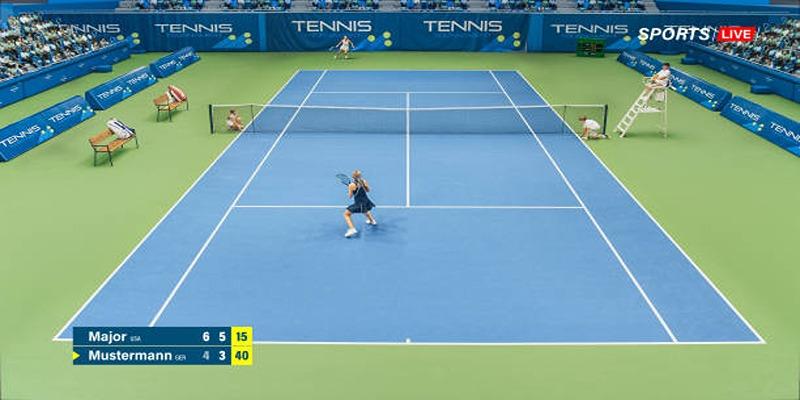
Kalman filtering opens up a greater data space that this game can integrate tracks into, which refers to the one based on broadcasting, and thus necessitates a new set of analyses. In the case of tennis, we may justifiably:
- Calculate Player Speed and Distance: Measure the total distance a player covers during a match and their average or top speeds.
- Generate Heatmaps: Visualize a player's court positioning and tactical preferences.
- Analyze Shot Patterns: Correlate player movement patterns with specific shot types and outcomes.
- Automate Tactical Analysis: Identify recurring patterns like a player's tendency to approach the net or stay on the baseline.
It is all possible without costly on-site sensor systems, providing access to high-quality sports analytics for coaches, analysts, and even amateur enthusiasts in a more democratic manner.
Final Thoughts
Zero-shot object detections are capable of detecting athletes in virtually any video, whereas the raw results are subjective and hardly accurate enough to determine details. Invoke the Kalman filter - a post-processing utility to fix jammed up detections into a smooth action battery. It accurately predicts poses and handles occlusions, transforming basic detectors into robust tracking systems, and finds their use necessary for deriving valuable information from sports video segments.