
Linear programming might sound complex, but at its core, it's just a method to help make the best use of what you’ve got. Imagine having a fixed amount of time, money, or materials and needing to figure out the smartest way to use it. That’s the idea behind linear programming. It gives you a structured way to make decisions when you’ve got limited resources and more than one way to use them.
It uses math, yes, but the basic concepts are very practical. You start with a goal, called the objective function, which could be something like reducing cost or increasing profit. Then you look at your limits, which are called constraints. These are things like budgets, time, material limits, or labor hours. Linear programming helps you figure out the best possible result within those limits.
What Linear Programming Actually Solves?
The whole point of linear programming is to solve problems that involve planning, managing, or scheduling. But instead of guessing or going with gut instinct, it gives you a way to make choices that actually make the most sense based on facts. It’s like putting a messy situation into order.
While it’s true that companies use it for big decisions like manufacturing or shipping, the same kind of logic applies in daily situations too. Even deciding how to fit your weekly errands into limited free time is a mini version of this. You’re making trade-offs based on constraints and choosing what gives the best results.
Variables, Constraints, And The Objective Function
In linear programming, variables represent the factors you can adjust within a problem. These variables form the basis for the choices being made and determine how different outcomes can be achieved. The objective function expresses the goal of the problem, whether it is to achieve the highest benefit or the lowest cost. It gives direction to the entire process by showing what needs to be optimized.
Constraints act as the boundaries that limit the values these variables can take. They define the conditions under which the objective must be achieved and represent the restrictions that cannot be ignored. These constraints are expressed in a way that outlines what is permitted within the problem.
By combining the objective function with the constraints, linear programming finds the most suitable solution that stays within these defined boundaries. It is not about selecting any outcome but about identifying the best possible option that remains feasible under all conditions.
Finding The Best Possible Outcome
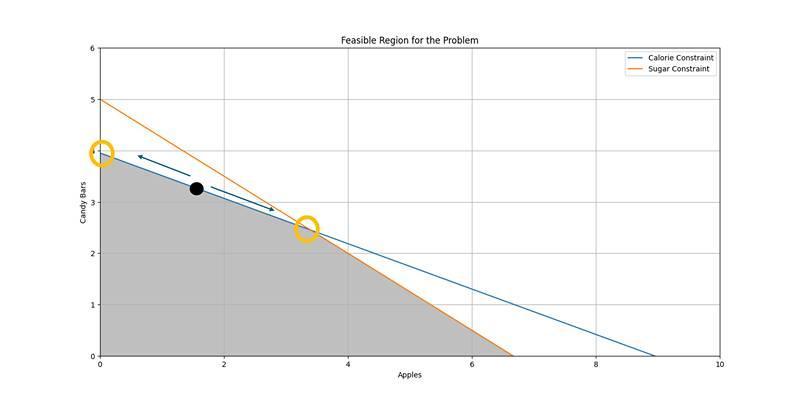
Once everything is written out—the goal, the variables, and the limits—you’re looking to find the best combination that fits within those limits. This is where the idea of the feasible region comes in. Think of this as the space where all your rules overlap. Any solution outside of that space breaks one of your constraints, so it’s not allowed.
The goal is to find the point inside this region that gives you the best result for your objective function. If your goal is profit, you want the point that gives the highest value. If your goal is cost, you want the lowest value. That’s called the optimal solution.
Reaching this solution isn’t about luck. It comes from using logic, structure, and clarity. When done right, it helps turn uncertainty into confident decision-making. It gives you direction when choices feel unclear. And it brings focus when the options feel overwhelming.
How is the Problem Solved Behind The Scenes?
To find this optimal solution, there are mathematical methods that can be used. The most well-known one is the Simplex Method. It checks all the corners of the feasible region and figures out which one gives the best result. Most of the time, people don’t do this by hand. There are software tools and calculators that handle the actual solving. What’s useful is understanding the process, even if you're not doing the math yourself.
Now, sometimes you might find that more than one solution works equally well. That means you’ve got a few different options that give the same result. Other times, you might find that no solution exists at all.
That happens when your constraints are too strict or don’t allow any solution that satisfies all the rules. This is called an infeasible problem. It’s also possible to have what’s called an unbounded solution, where there’s no limit to how much better your outcome can get. That usually happens when you forget to include one of the limits that should have been there.
When Linear Programming Works And When It Doesn’t?

Linear programming works great when the relationships between your variables are linear—that means they go up or down at a steady rate. If your problem involves curves, randomness, or anything unpredictable, linear programming won’t be enough. You’d need a different type of model.
Still, for a huge number of planning problems, LP gives a clear and reliable path. It helps strip away distractions and gets to the heart of what you’re trying to solve. It turns a confusing mess of options into something you can actually work with.
And even though it involves math, the thinking behind it is completely logical and grounded. You're not guessing. You're not just hoping for the best. You're looking at what you have, what you want to achieve, and what you’re allowed to do—and finding the smartest plan that fits all of that.
Conclusion
Linear programming optimization is really just about making smarter decisions when resources are tight. It lets you figure out how to get the best result without breaking your limits. Whether you're trying to cut costs, save time, or make the most of what you have, linear programming helps you find a path that actually makes sense.
You don’t need to be a math expert to appreciate how useful it can be. If you can understand your goal, your limits, and your options, then you already think like someone who uses linear programming.